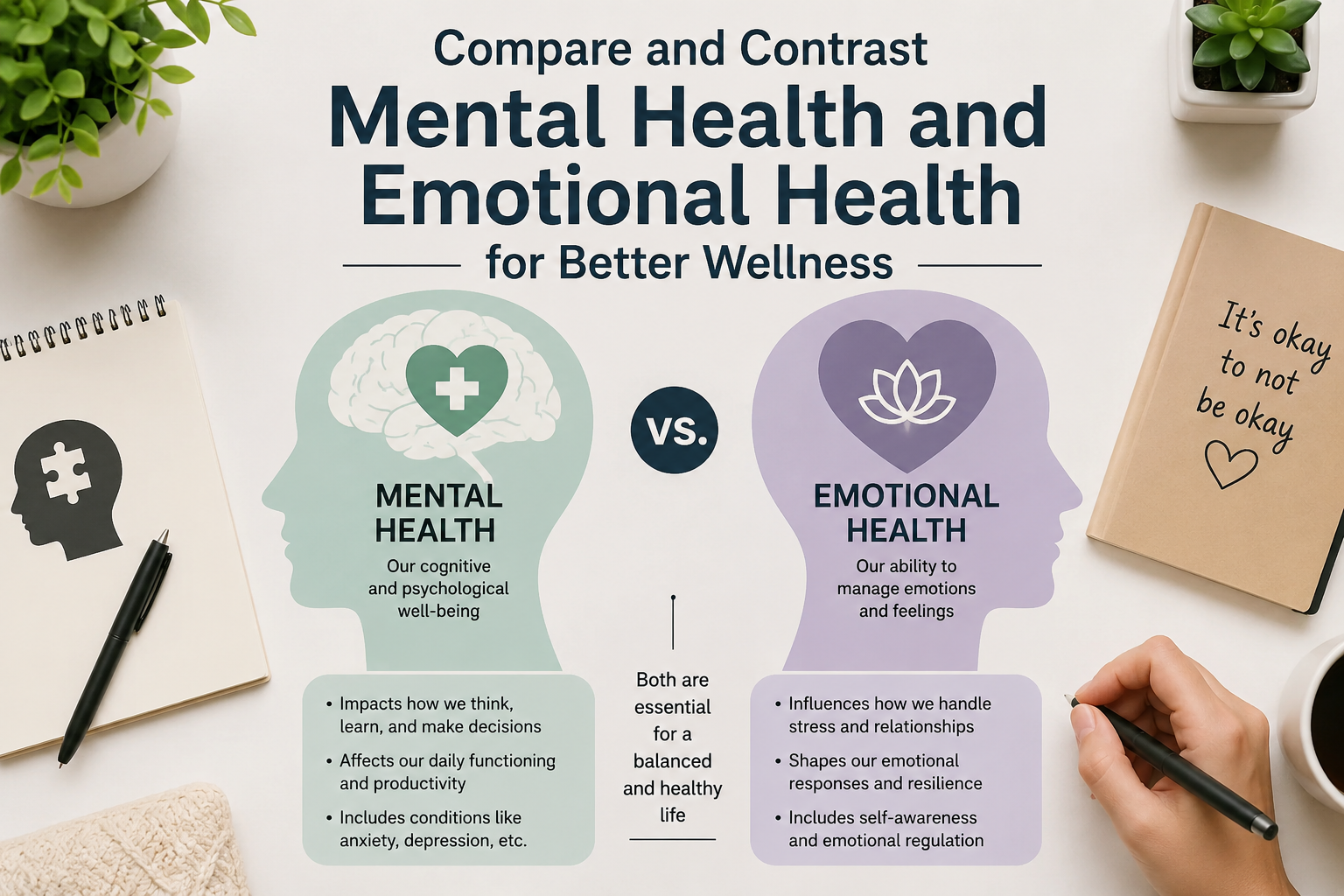
Mental health refers to your overall psychological state including how you think, process information, and handle cognitive and behavioral functioning. Emotional health refers specifically to how well you recognize, express, and regulate your emotions in daily life. They overlap significantly but are not the same thing.
Most people use these two terms interchangeably, but understanding where they differ helps you take a more targeted approach to your own wellbeing. You can have strong emotional health and still struggle with a clinical mental health condition, and vice versa.
This breakdown covers both concepts clearly so you know exactly what each one involves and how improving one tends to support the other.
Key Takeaways
- Mental health is your overall psychological state. Emotional health is specifically about feeling and regulating emotions.
- They overlap significantly but are not identical concepts.
- You can have good emotional health while managing a clinical mental health condition.
- Improving emotional regulation skills often supports better mental health outcomes.
- Sleep, exercise, social connection, and professional support benefit both areas.
- Clinical mental disorders require professional assessment. Emotional health skills are something anyone can build.
What Is Mental Health: A Clear Definition
Mental health is the state of your psychological and cognitive wellbeing. It includes how you think, reason, perceive your environment, and cope with the demands of daily life.
Good mental health does not mean the absence of mental illness. It means you can function effectively, maintain relationships, handle stress, and recover from setbacks.
What Mental Health Covers
● Cognitive function: how well you think, focus, remember, and process information
● Psychological stability: your ability to handle stress, uncertainty, and life challenges
● Behavioral patterns: how mental state influences your actions and decisions
● Presence or absence of diagnosable mental health conditions such as anxiety disorders, depression, or PTSD
The 7 Types of Mental Disorders
● Anxiety disorders: excessive worry, panic attacks, phobias
● Mood disorders: depression, bipolar disorder
● Psychotic disorders: schizophrenia and related conditions
● Eating disorders: anorexia, bulimia, binge eating disorder
● Trauma-related disorders: PTSD, acute stress disorder
● Personality disorders: borderline, narcissistic, and others
● Substance use disorders: dependency on alcohol, drugs, or other substances
These are medical conditions that often require professional assessment and support. Emotional health strategies alone are not a replacement for professional treatment of clinical mental disorders.
What Is Emotional Health: A Clear Definition
Emotional health refers specifically to your relationship with your own emotions. It is about how well you recognize what you are feeling, express those feelings in healthy ways, and regulate emotional responses especially in stressful situations.
Someone with strong emotional health can acknowledge difficult emotions like anger, grief, or disappointment without being controlled by them. They can adapt, process, and move forward.
10 Examples of Emotional Health in Daily Life
● Recognizing when you feel anxious and taking steps to calm yourself
● Communicating frustration without aggression or passive withdrawal
● Accepting constructive criticism without excessive self-criticism
● Setting boundaries in relationships without guilt
● Grieving a loss while still maintaining daily functioning
● Feeling happiness or gratitude and allowing yourself to experience it fully
● Recovering from disappointment without dwelling on it for days
● Asking for help when you are overwhelmed
● Sitting with discomfort without immediately numbing it
● Expressing needs clearly to people around you
Mental Health vs Emotional Health: Side by Side Comparison
| Aspect | Mental Health | Emotional Health |
| Focus | Overall psychological functioning and cognitive state | Awareness and regulation of emotions |
| Scope | Broader: includes thoughts, behavior, and conditions | Narrower: specifically about feelings and expression |
| Measurement | Can involve clinical diagnosis | More self-assessed and relational |
| Affected by | Brain chemistry, trauma, genetics, stress | Life experiences, relationships, coping habits |
| Support | Therapy, medication, structured treatment | Journaling, mindfulness, communication skills |
| Overlap | Poor mental health often disrupts emotional balance | Poor emotional health often worsens mental state |
How Mental Health and Emotional Health Influence Each Other
These two aspects of wellbeing are deeply interconnected. Chronic emotional suppression is associated with increased risk of anxiety and depression, both of which are mental health concerns.
Conversely, untreated depression often makes emotional regulation much harder. A person struggling with depression may find it difficult to process grief, experience joy, or manage anger effectively.
Working on one tends to benefit the other. Improving emotional awareness through journaling or therapy often reduces anxiety. Managing a mental health condition through treatment often allows emotional expression to become more natural.
Top 10 Tips for Maintaining Both Mental and Emotional Health
● Practice daily mindfulness or even 5 minutes of quiet breathing to interrupt stress cycles
● Journal regularly to process emotions before they build into something harder to manage
● Maintain consistent sleep patterns as sleep deprivation directly impacts both mood and cognitive function
● Limit alcohol and avoid substance use as coping mechanisms
● Stay physically active as movement has well-documented effects on mood and anxiety levels
● Build and maintain at least a few close, honest relationships where you can be yourself
● Set and protect personal boundaries in work and personal life
● Seek professional support early rather than waiting for a crisis point
● Limit social media consumption if it consistently triggers comparison or negative emotion
● Engage in activities that give you a sense of purpose or creative expression
Nutrition has a measurable effect on mood, cognitive function, and stress resilience. People managing emotional health alongside lifestyle changes can find a useful starting point in the healthy eating guide, which covers how food choices influence energy levels and mental clarity throughout the day.
What Good Mental Health Looks Like Day to Day
● You can concentrate and make decisions without being paralyzed by worry
● You feel a general sense of purpose in what you do
● You can engage meaningfully in relationships
● You recover from setbacks within a reasonable time
● You are aware when you need support and willing to seek it
Expert Insights
Mental health professionals consistently distinguish between emotional regulation as a skill and mental illness as a condition. Emotional health can be actively trained and improved through practice. Mental health conditions, particularly clinical ones, typically require professional support.
The connection between stress, emotional health, and body weight is well established. Chronic stress raises cortisol levels, which directly promotes fat storage. People dealing with stress-related weight gain may find it useful to read about sustainable approaches to fat loss in how to lose 20 pounds in a month, which covers stress and sleep as part of the weight management process.
Frequently Asked Questions
What are the differences between mental health and emotional health?
Mental health refers to your overall psychological functioning including thoughts, cognition, and mental health conditions. Emotional health refers specifically to how well you identify, express, and manage your emotions. Mental health is broader in scope; emotional health is more specifically about your relationship with feelings.
What is the definition of mental health?
Mental health is a state of psychological wellbeing in which a person can think clearly, cope with life stress, maintain relationships, and function effectively. It includes the absence of clinical mental disorders and the presence of positive psychological functioning.
What are 10 examples of emotional health?
Recognizing emotions without judgment, expressing feelings clearly, recovering from disappointment, setting healthy boundaries, asking for help, feeling genuine joy, grieving without becoming stuck, managing anger constructively, communicating needs openly, and sitting with discomfort without numbing it.
What are the top 10 tips for maintaining mental health?
Regular sleep, physical activity, journaling, mindfulness practice, maintaining social connections, limiting alcohol, seeking therapy when needed, setting boundaries, limiting excessive social media, and engaging in purposeful activities are consistently recommended for mental health maintenance.
What are the 7 types of mental disorders?
The major categories are anxiety disorders, mood disorders, psychotic disorders, eating disorders, trauma-related disorders, personality disorders, and substance use disorders. Each requires professional diagnosis.
How does US mental health compare to other countries?
The US has high rates of diagnosed mental health conditions relative to many other countries, reflecting both higher prevalence and a more robust diagnostic culture. Access to treatment varies significantly by income, location, and insurance coverage.
Final Thoughts
Understanding the distinction between mental health and emotional health helps you take a more targeted approach to your own wellbeing. They are not the same thing, but they support each other in meaningful ways.
Building emotional awareness and regulation skills is something anyone can do at any stage of life. Addressing mental health challenges, especially clinical ones, benefits from professional guidance. Working on both together leads to the most sustainable improvements in overall quality of life.
.png)
Written by
Sarah Mitchell
Health & Wellness Writer
Sarah Mitchell is a health and wellness writer focused on nutrition, healthy eating, and practical lifestyle topics. She creates well-researched, accessible content designed to help readers explore everyday health and wellness.